Over 550 hp,Over 2500 ft-lbs torque from start up to 1200 RPM, Multi-fueled and over 50% fuel efficiency, Only 9 main moving parts, Under 300 lbs, No transmission needed

internal combustion     4-Stroke OTTO Cycle

Legend

Intake
Compression
Combustion
Exhaust

CLICK ON THE PLAY BUTTON BELOW TO VIEW THE EXTERNAL COMBUSTION - RANKINE CYCLE STEAM ENGINE CONCEPT


VENGEANCE POWER ENGINE COMES TO LIFE ON STEAM


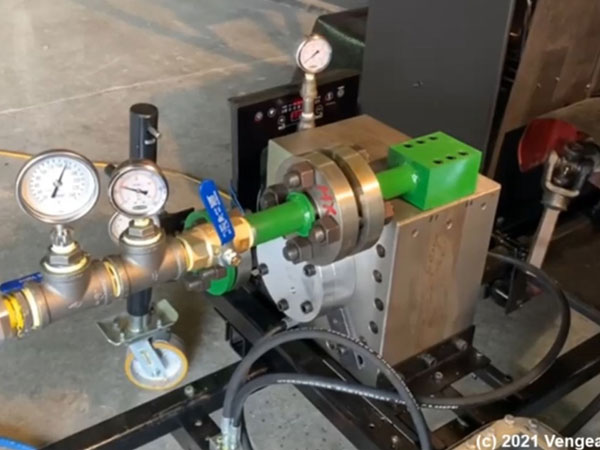
Click on the image below
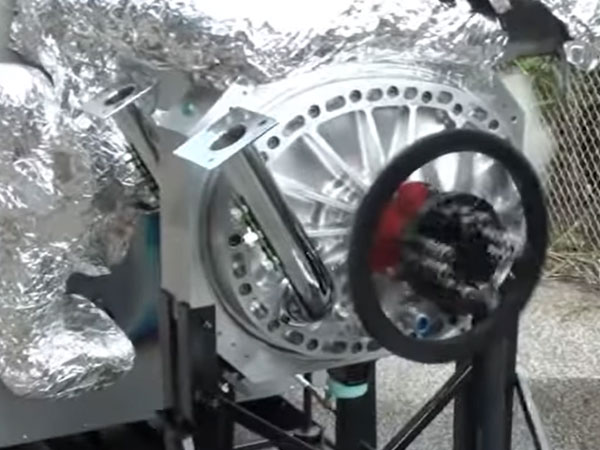
to see steam power and torque tests.  These tests were conducted to demonstrate that the Vengeance Power Engine can easily be converted from an internal combustion engine to an external combustion engine just by introducing steam pressure through the spark plug location. This was an open loop cycle, so the steam was not recycled as in a closed loop cycle where the steam is condensed and re-heated.  This also shows the tremendous torque of the Vengeance Power Engine.

A dedicated Vengeance Power Steam Engine will have an engine block machined to utilize the steam pressure in a much more efficient manner. This is accomplished by introducing steam at opposite sides of the rotor and having the nozzles positioned when the vanes are fully extended, taking advantage of the mechanical leverage produced to maximize torque.  The present size of this engine using 500 psi of steam pressure would produce over 4000 ft.lb of torque. 


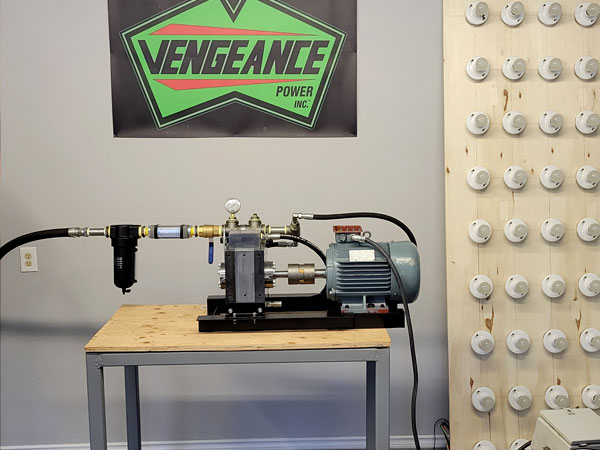
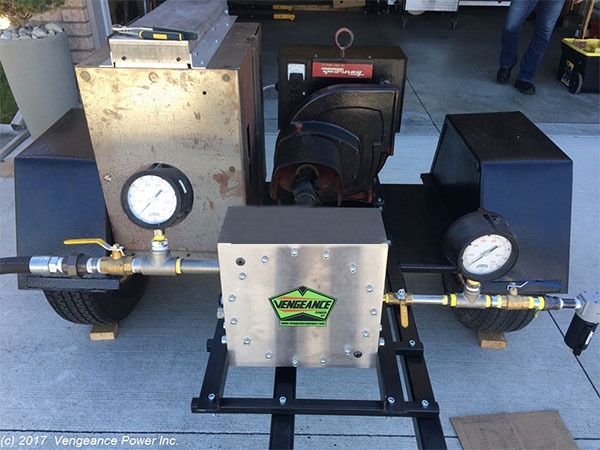
VENGEANCE POWER ENGINE FLEXES ITS MUSCLE ON COMPRESSED AIR

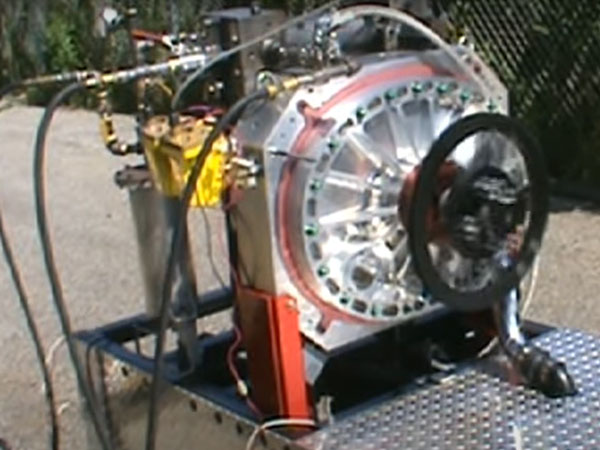
Click on the image below to see the Vengeance Power Engine running on compressed air.   These tests were performed using standard shop air at 100 PSI pressure, producing 760 ft.lb. Net Torque.  This clearly demonstrates the tremendous torque capability of our engine.


STEAM CAR CONCEPT
 
This is a concept steam powered car we would be using with our engine.  This vehicle will also be used to make an attempt for the world land speed record for steam vehicles.  This record is currently held by a British team set at approximately 148 Miles per Hour.   We are confident that this test vehicle powered by the Vengeance Power Engine will have no problem exceeding 150 Miles per Hour. 


This vehicle will be able to use anything that can burn for power.  With the flick of a switch, it will be able to make the transition from external combustion running on steam to internal combustion running on conventional fuels.   Everyone should be looking more closely at steam power.  With today’s alloys, power plants are achieving over 50% efficiency.  We want to bring that same efficiency to the marketplace.

Not too many people know that today’s batteries have a limited life cycle and have to be thrown away after so many recharges.  This is another reason why we should be looking for other energy alternatives.  With our steam engine concept, it would not require a drastic change in the manufacturing process infrastructure.  We hope to receive all the support that is needed to bring this technology to the market.

VENGEANCE POWER ENGINE COMES TO LIFE ON PROPANE

Click on the image below
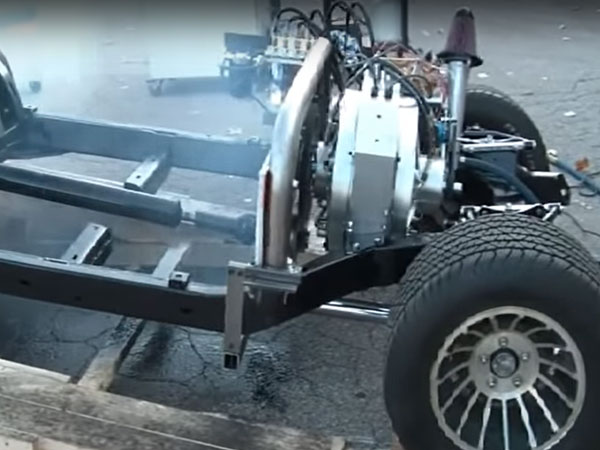
to see the Vengeance Power Engine running on propane mounted in a 1972 Corvette Chassis.  These tests were conducted to determine the correct air/fuel mixture and proper ignition timing. These tests also demonstrated the power output of this engine concept as seen when the car chassis began to pull forward whenever the engine fired. The engine ran without coolant, oil pressure and throttle control; this was seen when the engine began to accelerate and the fuel regulator could not keep up with the incoming air charge. When this happened, the engine began to misfire as a result of an overly lean air/fuel mixture.
The late timing also caused backfiring through the exhaust which can be seen from the flames shooting out the exhaust pipe.

The next testing phase will be done with more controls for throttling air intake , oil, coolant and timing.
This engine concept has patents pending worldwide. At this point since the concept has been proven and the mechanics of this engine are sound and robust, it is ready for licensing for any application including external combustion which includes steam power.


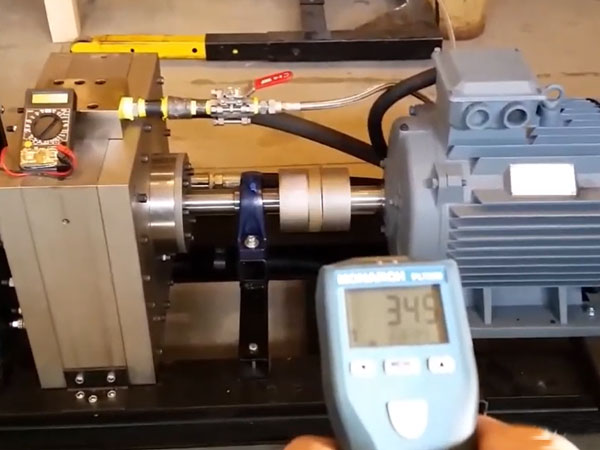
Click on the picture below to see a video of the Vengeance Power Engine featured at the 2010 SAE World Congress proving out the concept at an internationally recognized dyno testing facility in Auburn Hills, Michigan.  

This test was conducted using 100% ethanol fuel and could have easily been conducted with other fuels including gasoline.  With over 50% blow-by through the hand-fabricated prototype seals, the engine was still able to deliver over 300 foot pounds of torque at 200 rpms without oil pressure and without any coolant.  The exhaust temperature registered a cool 247 Degrees Celsius during the test indicating the high thermodynamic efficiency of the engine.   This means that more heat energy is being transferred into mechanical energy instead of being wasted out the exhaust as with a piston engine.   Now that the concept has been proven, the next phase will be to refine the seal design and perform endurance and maximum power output testing.


Click on the picture below to see a video of the Vengeance Power Engine Natural Gas combustion test.


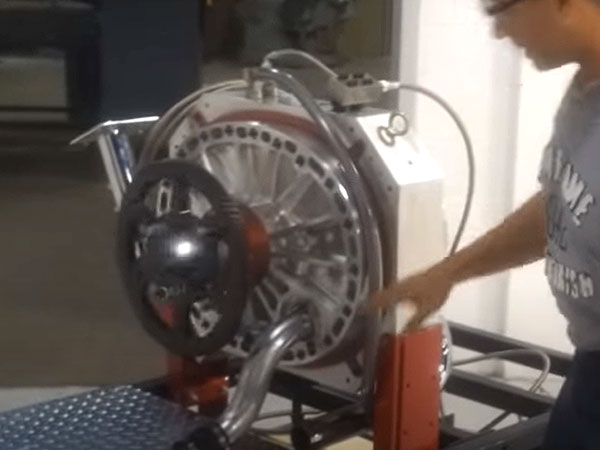
This test was to prove that combustion of the natural gas/air mixture occurred in the correct chamber at the correct time as designed.  This test was not intended to prove out self sustaining rotation as only prototype seals were used, which provided intermittent pressure pulses.  These pressure pulses pushed on the vanes and turned the rotor momentarily.  This can clearly be seen by the frequent loss of tension on the chain when the engine over-ran the starter motor.  The natural gas regulator had to be manually adjusted with an extended rod to maintain the proper air/fuel stoichiometric ratio throughout the test run.  Modifications to the seals are being completed and another combustion self sustaining rotation test will be conducted soon.  Stay Tuned!!

 .  


THE POWER OF LEVERAGE

The Vengeance Power Engine was developed to take advantage of the explosive force of combustion and applying the pressure directly into rotational motion.  This is much more efficient than transferring reciprocating motion of a piston into the rotational motion of the output shaft using a crankshaft.  Thus the Vengeance Power Engine is a true rotary engine.  Other engines called rotaries are not rotaries since the eccentric output shaft is really a crankshaft. 

After combustion occurs, the peak pressure inside the piston engine is reached well before the crankshaft has reached its 90 Degree rotation where maximum leverage happens.  By the time the crankshaft does reach its maximum leverage point, the pressure inside the cylinder has dropped to almost nothing.

The Vengeance Power Engine provides the maximum pressure directly at 90 Degrees of rotation at all times.  A conventional V8 piston engine delivering around 500 HP will have between 2-3 inches of throw (crank leverage) while a comparable Vengeance Power Engine will have between 7-8 inches of leverage.

Therefore it is clearly seen that with greater leverage, the pressure from combustion will provide a lot more torque resulting in greater efficiency.  A Vengeance Power Engine is like having a bicycle with an eight inch pedal arm compared to a bicycle with a two inch arm.  The eight inch pedal arm will provide a lot more torque when climbing a hill than a two inch pedal arm.


Combustion approximately 10 Degrees after TDC.  Pressure in Vengeance Power Engine pushing directly in a rotational motion rather than trying to hammer the piston, connecting rod and crankshaft out the bottom of the engine, wasting tremendous energy.

The volumetric efficiency in a piston engine is greatly restricted by the design of the valve-train. The Vengeance Power Engine overcomes this restriction by eliminating the valve-train altogether.  The incoming air is free to fill the intake chamber to its maximum volume at any RPM, which translates to maximum torque at any RPM.
The main purpose for a transmission in a piston engine vehicle is to take advantage of the volumetric efficiency of the engine.  The transmission allows the engine to rev up to its power band then it shifts to a higher gear as the vehicle accelerates.  The piston engine does not provide maximum torque at all RPM due to the valve-train restriction.  Since the Vengeance Power Engine provides maximum torque at any RPM, the need for a conventional transmission is eliminated. 

Many times the piston engine is called an “incomplete combustion engine”.  The reason is because the time frame for a complete combustion inside the piston engine is very small.  As the piston reaches TDC, (top dead center), the air/fuel mixture has to ignite and complete its combustion before the exhaust valve is opened.  Since the exhaust valve opens well before all the fuel is burned, the unburned fuel leaves the exhaust port and into the catalytic converter which completes the combustion process.
This is why the inlet temperature of the catalytic converter is less than the outlet temperature.
If more of the fuel is allowed to combust inside the engine rather than the exhaust, the power output of the engine would increase resulting in greater efficiency and cleaner emissions.
The Vengeance Power Engine takes advantage of the great amount of time at TDC (dwell time) and allows more of the fuel to combust inside the engine and not in the exhaust.

The unique shape of the Vengeance Power Engine block allows more of the heat from combustion to remain inside the combustion chamber resulting in a more complete combustion.  This feature raises the thermodynamic efficiency, unlike a piston and other rotaries where the volume increases too rapidly dropping the pressure and killing the heat for complete combustion.  Again, the result of incomplete combustion is higher emissions out of the exhaust.


© 2009 Vengeance Power Inc.